Curia turns thousands of texts, emails, and records from a custody or divorce matter into a clear, source-traced timeline — so your hours go to strategy, not sorting.
Curia preserves originals and traces every item back to its source — so your authentication work is faster and verifiable. Those calls are always yours.
Working with family-law attorneys across Arkansas — expanding soon.
Henderson v. Henderson
Issue Index
Auto-organized
Communication & co-parenting
31 messages · traced to source contradiction flagged
Financial conduct
18 records · bank + text references reconciled
Safety & protective-order history
7 incidents · chronological, dated to source
Child welfare & schedule
24 entries · calendar + message corroboration
The line that never moves
Curia organizes and surfaces.You decide what's relevant, admissible, and strategic.
The problem
Every matter buries you in evidence before you can build the case.
The facts that decide a custody or divorce case arrive as a disordered pile — and turning it into usable work product is slow, billable, and easy to get wrong.
One
Missed exchange can turn a case
A single buried contradiction or timeline gap is the difference between a strong position and a weak one.
New
Liability for the wrong tools
Under the 2025 ethics rules, AI output is now the supervising attorney's responsibility. Getting this wrong has consequences.
Recent Arkansas ethics guidance on attorney responsibility for AI output.
The risk isn't theoretical, and it's local. Recent Arkansas ethics guidance now puts responsibility for AI output on the supervising attorney — and attorneys have already faced court scrutiny for unverified AI citations. Family law, AI risk, and real consequences — in our own backyard.
What you get
Disordered evidence in. A source-traced timeline out.
Whatever the client hands over — in whatever format — Curia organizes it by issue, traces every point to its source, and flags what doesn't line up. Nothing interpreted. Everything verifiable.
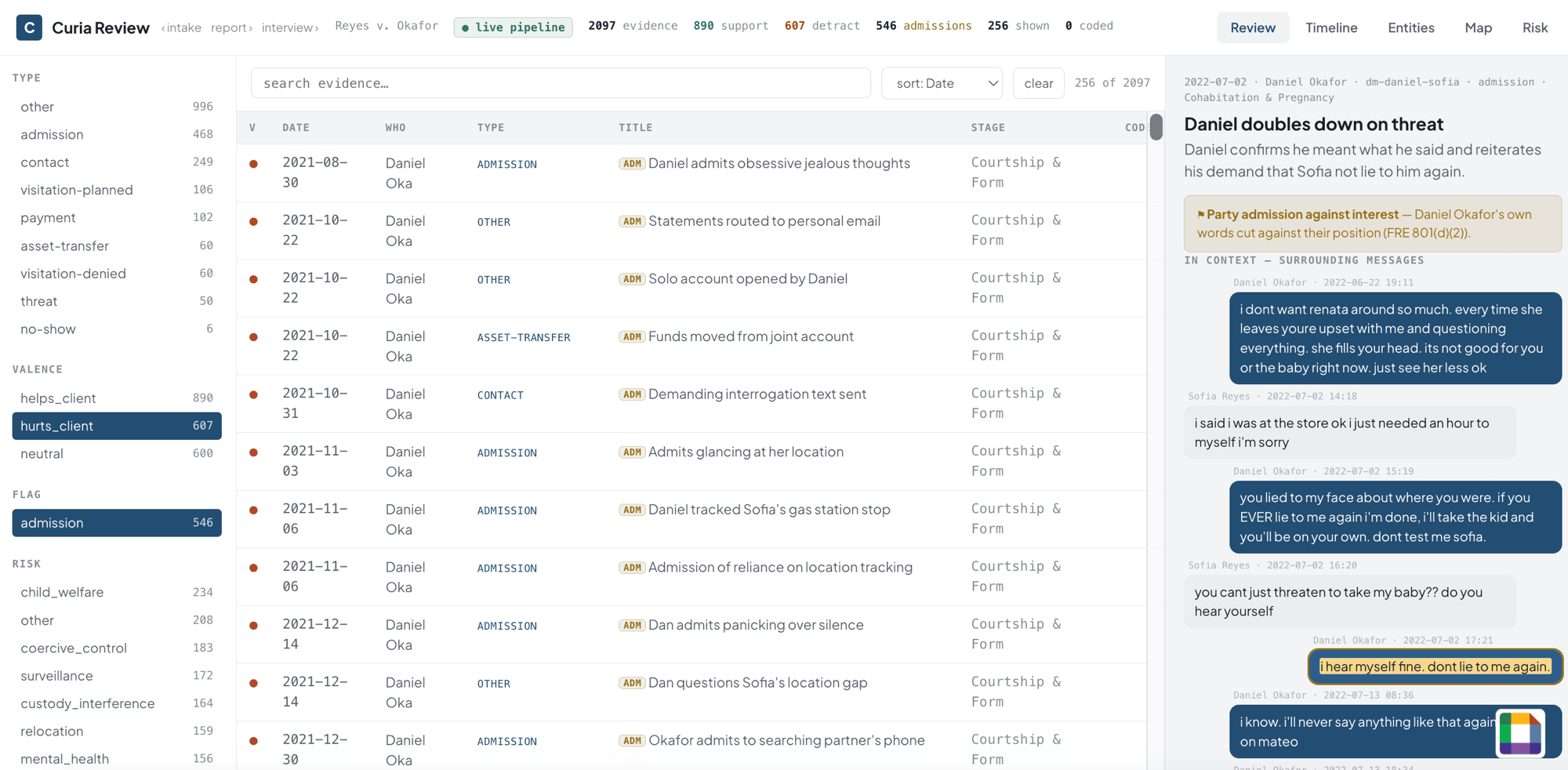
Curia · Reyes v. Okafor
Filter the entire record by type, admission, or risk theme — each item traced to its source and shown in context, so the exchange that matters is one click away.
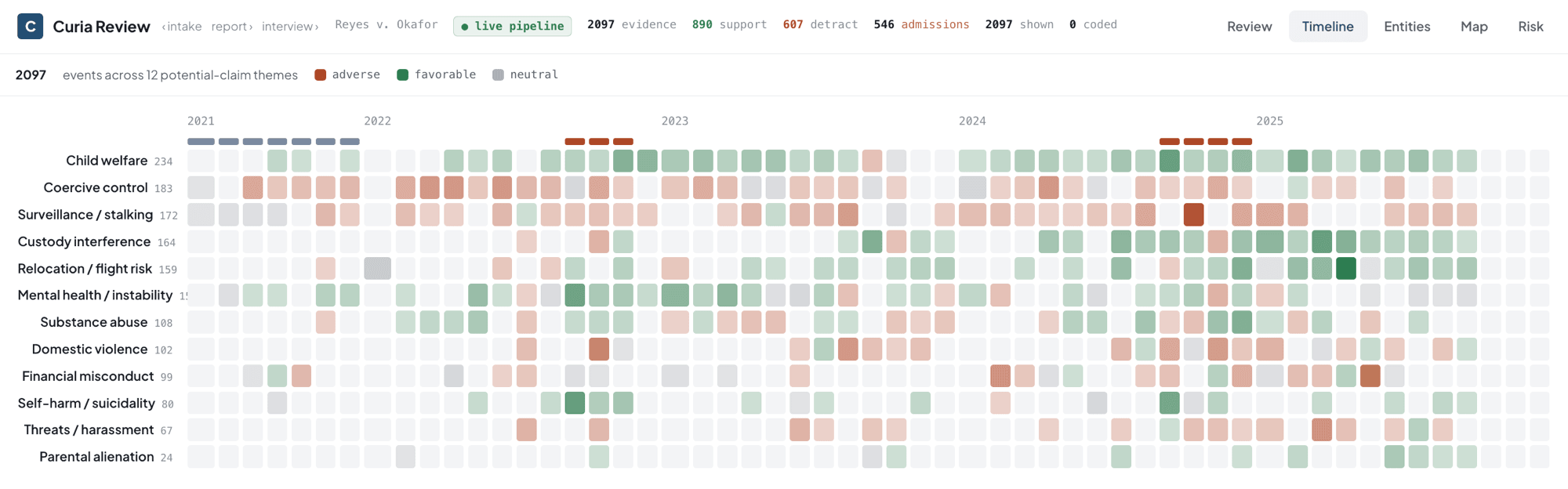
Curia · Timeline
The entire record mapped — every claim theme, every year, adverse and favorable at a glance.
Shown on de-identified sample data. Names and content are fictional.
40–60
hours saved per matter. The printing, reading, and sorting that used to eat days before strategy even began — Curia does it in minutes.
Our own estimate, from matters we've built by hand.
Design partners
We're building this with practicing attorneys.
Curia is being shaped alongside family-law attorneys handling real matters — so the work product fits how you actually practice. The pressure behind it is already here:
The rules arrived
Recent ethics guidance puts responsibility for AI output squarely on the supervising attorney.
Recent Arkansas ethics guidance.
The risk is local
An Arkansas attorney has faced court scrutiny over unverified AI citations.
The pattern is growing
1,600+ court decisions worldwide have now addressed AI-hallucinated filings.
AI Hallucination Cases DB, 2026
Join the waitlist
Be first in line as Curia opens up.
Tell us a little about your practice and we'll reach out as spots open.
For attorneys & firms
Case intelligence for your practice.
Walk into every hearing in command of the record. Curia reads thousands of texts, emails, and filings, organizes every matter, and traces each item back to its source — so nothing surprises you and nothing goes unverified. The strategy stays yours.
Prefer to see it first? Email Leah for a 30-minute walkthrough — a real, de-identified matter, no pitch.